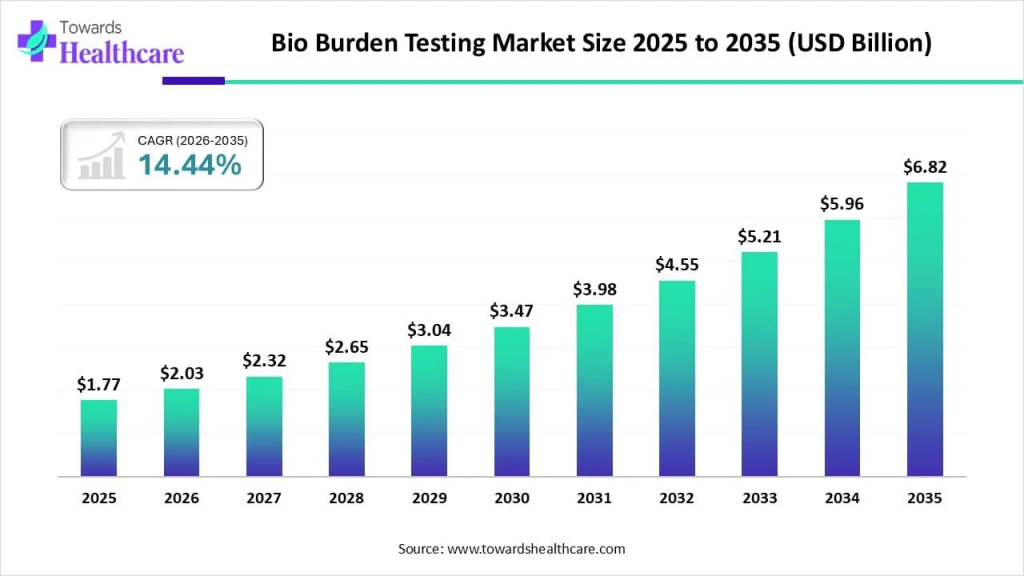
Bioburden testing is becoming increasingly important across pharmaceutical, biotechnology, medical device, food, and healthcare industries as manufacturers face stricter requirements for microbial contamination control and product safety. The global bioburden testing market is projected to grow from USD 1.77 billion in 2025 to USD 6.82 billion by 2035, registering a 14.44% CAGR from 2026 to 2035.
Bioburden testing measures the number of viable microorganisms present in products, raw materials, medical devices, and manufacturing environments before sterilization or final release. It plays a critical role in identifying bacterial, fungal, and other microbial contamination and helps manufacturers maintain consistent quality and meet regulatory requirements.
Why Is Bioburden Testing Becoming More Important?
The expansion of pharmaceutical and biotechnology manufacturing is creating greater demand for reliable microbial quality control. The growing production of biologics, vaccines, cell and gene therapies, and personalized medicines requires highly controlled manufacturing environments where even small levels of contamination can affect product safety and quality.
At the same time, regulatory expectations are becoming more stringent. Pharmaceutical and medical device manufacturers are increasing routine microbial monitoring and investing in testing technologies that can deliver more consistent and accurate results.
Another important shift is the move toward rapid microbial detection. Traditional culture-based techniques remain widely used, but advanced approaches such as PCR, flow cytometry, ATP bioluminescence, and next-generation sequencing are gaining attention because they can shorten testing timelines and support faster product-release decisions.
AI and Automation Are Changing Microbial Testing
Artificial intelligence and laboratory automation are becoming important tools for modern microbial quality control.
AI-enabled systems can assist laboratories with:
- Automated analysis of microbial testing data
- Pattern recognition and contamination tracking
- Predictive quality monitoring
- Reduction of manual errors
- Faster interpretation of test results
- Improved laboratory workflow management
Automation is also helping laboratories process larger testing volumes while maintaining consistency. As pharmaceutical manufacturing becomes more digital, the integration of AI, robotics, and laboratory information systems is expected to become increasingly important.
Key Trends Shaping the Industry
1. Rapid Microbial Detection
Manufacturers are increasingly looking for testing approaches that provide reliable results faster than conventional methods. This is particularly important when delays in microbial testing can slow pharmaceutical or medical device production.
2. Expansion of Outsourced Testing
Pharmaceutical and medical device companies are increasingly working with specialized contract testing laboratories. These providers offer technical expertise, validated procedures, regulatory knowledge, and laboratory infrastructure without requiring manufacturers to build every capability internally.
3. Growth of Biologics and Advanced Therapies
Biologics, vaccines, cell therapies, and gene therapies require stringent contamination control throughout production. Their increasing development is creating additional demand for robust microbial testing at different stages of manufacturing.
4. Increasing Laboratory Automation
Automated microbial detection systems, PCR instruments, colony counters, and digital laboratory platforms are helping laboratories improve efficiency, consistency, and testing capacity.
5. Greater Focus on Environmental Monitoring
Environmental monitoring is becoming increasingly important in pharmaceutical manufacturing and controlled production environments. Faster microbiological methods can support more frequent monitoring and help identify contamination risks earlier.
Segment Insights
Consumables accounted for the largest product share in 2024, representing nearly 60%, supported by recurring demand for culture media, reagents, test kits, biological indicators, contact plates, and membrane filters. Instruments, meanwhile, are expected to experience rapid expansion as automation and advanced detection technologies become more widely adopted.
By testing method, aerobic count testing held the leading position with approximately 35% share in 2024. Fungi and mold count testing is expected to expand rapidly as manufacturers pay greater attention to fungal contamination and associated product-safety risks.
By technology, culture-based testing represented approximately 55% of revenue in 2024. However, advanced rapid testing methods are expected to record faster growth as manufacturers seek shorter turnaround times. PCR-based testing is particularly promising because of its speed, sensitivity, and compatibility with automated workflows.
By application, final product testing accounted for around 40% of the industry in 2024. Environmental monitoring is expected to gain momentum as pharmaceutical manufacturing becomes more dependent on controlled environments and advanced contamination-monitoring practices.
Regional Outlook
North America held the leading position with approximately 38% share in 2024. The region benefits from advanced healthcare infrastructure, established pharmaceutical and biotechnology industries, sophisticated laboratory capabilities, and strong regulatory requirements.
The United States remains a major contributor because of its large pharmaceutical and biotechnology ecosystem and strong focus on product quality and regulatory compliance.
Meanwhile, Asia Pacific is expected to experience the fastest growth. Pharmaceutical manufacturing expansion in India, China, South Korea, and other Asian economies, combined with growing generic drug and biologics production, is increasing the need for microbial quality-control solutions.
Competitive Landscape
Leading companies are strengthening their capabilities through new technologies, laboratory expansion, partnerships, and advanced testing solutions.
Key participants include:
- Charles River Laboratories
- Merck KGaA
- Thermo Fisher Scientific
- SGS
- BD
- bioMérieux
- Eurofins Scientific
- Nelson Laboratories
- WuXi AppTec
- Pace Analytical Services
- Lonza
- Steris
- Rapid Micro Biosystems
- Labcorp
- NAMSA
These companies are competing through faster testing workflows, expanded laboratory networks, automation, specialized services, and improved regulatory support.
Future Outlook
The future of bioburden testing is moving toward speed, automation, digitalization, and greater testing precision. As pharmaceutical manufacturers increase production of complex therapies and regulators continue emphasizing contamination control, microbial testing will become an even more integrated part of modern manufacturing quality systems.
The strongest opportunities are likely to emerge around rapid microbial methods, AI-powered laboratory analytics, automated detection systems, outsourced testing, environmental monitoring, and advanced quality-control solutions.
With the global bioburden testing industry projected to reach USD 6.82 billion by 2035, the shift toward faster and smarter microbial quality assurance is likely to remain a major development across life sciences.
Download Customized Sample: https://www.towardshealthcare.com/download-sample/5852
About Us
Healthcare WebWire is a part of Towards Healthcare Research & Consulting is a global healthcare market research and consulting firm dedicated to helping businesses make informed decisions through reliable market intelligence and strategic insights. We serve pharmaceutical, biotechnology, medical device, AI in healthcare, cell and gene therapy, digital health, and life sciences organizations with in-depth market research, custom consulting, competitive analysis, and growth forecasts. Our team combines industry expertise with rigorous research to deliver clear, actionable insights that support market expansion, product strategy, investment decisions, and long-term business growth. From emerging innovations to established healthcare markets, we help organizations understand where the industry is today and where it’s headed tomorrow.
You can place an order or ask any questions, please feel free to contact us at [email protected]
Europe Region – +44 778 256 0738
North America Region – +1 8044 4193 44
APAC Region: +91 9356 9282 04
Visit Our Website: Towards Healthcare Research & Consulting – Expert Consulting Solutions & Research Reports
Find us on social platforms: LinkedIn | Twitter | Instagram | Medium