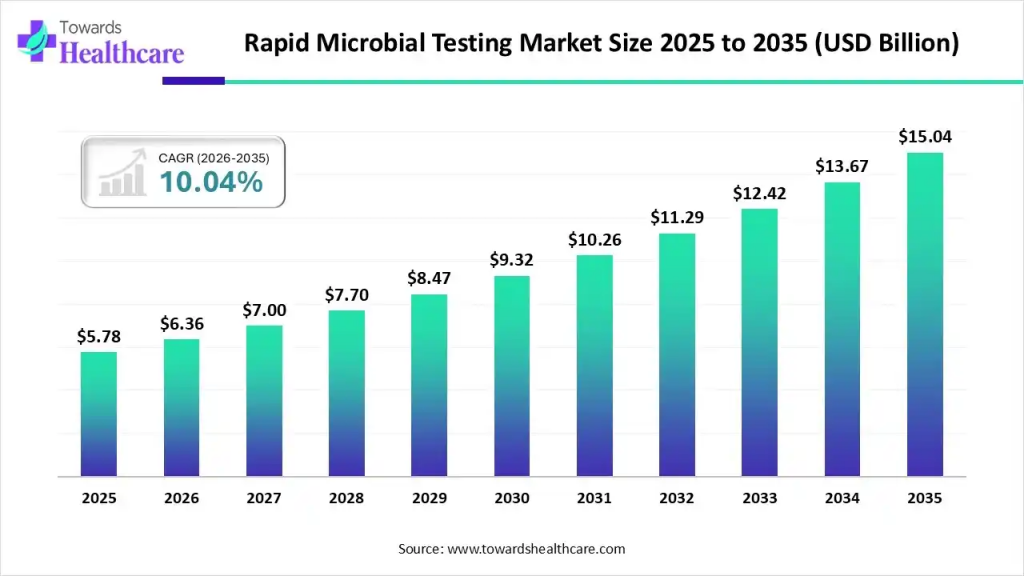
The need for rapid microbial testing is growing rapidly across pharmaceuticals, biotechnology, food safety, healthcare, and environmental monitoring. Rapid microbial testing technologies enable faster detection, identification, and quantification of microorganisms, helping laboratories improve contamination control, pharmaceutical sterility testing, bioburden testing, and quality assurance. As manufacturers increasingly seek faster product release and more efficient testing workflows, rapid microbial detection, microbial testing systems, and automated microbial testing solutions are becoming increasingly important.
What Is Rapid Microbial Testing?
Rapid microbial testing refers to advanced analytical techniques used to detect, identify, and quantify microorganisms in significantly less time than conventional culture-based approaches.
These technologies can be applied to:
- Pharmaceutical and biopharmaceutical products
- Cell and gene therapies
- Medical devices
- Food and beverages
- Water and environmental samples
- Clinical specimens
- Manufacturing environments
Common applications include sterility testing, bioburden testing, endotoxin detection, pathogen identification, and environmental monitoring.
The importance of faster detection is particularly evident in sterile pharmaceutical manufacturing. Conventional growth-based approaches remain widely used, but their longer turnaround times can delay manufacturing decisions. Research has highlighted the potential of rapid methods to provide quicker microbial insights while also noting challenges related to validation, cost, expertise, and regulatory acceptance.
Why Is Rapid Microbial Testing Gaining Attention?
The growing focus on product safety and contamination prevention is encouraging manufacturers and laboratories to adopt faster analytical workflows.
Pharmaceutical companies increasingly need timely information about microbial contamination during raw-material testing, production, environmental monitoring, and final product release. Rapid methods can potentially shorten the time between sampling and actionable results, supporting more responsive quality-control decisions.
The need becomes even more important for cell and gene therapies, where product shelf life can be extremely short. NIST’s Rapid Microbial Testing Methods Consortium has specifically focused on developing standards and measurement solutions that can support the adoption of rapid methods for advanced therapies.
PCR and Molecular Technologies Transform Detection
PCR-based methods remain among the most important technologies used for rapid microbial detection. Real-time PCR can amplify and detect microbial nucleic acids, allowing laboratories to obtain results much faster than waiting for visible microbial growth.
Other molecular approaches, including digital PCR and next-generation sequencing, are also expanding the technological possibilities.
NIST research has highlighted NGS-based workflows as an emerging approach for rapid microbial quality-control testing in biomanufacturing, including applications involving sterility and mycoplasma testing.
Microfluidics Enables Compact Testing Platforms
Microfluidics and lab-on-a-chip technologies are another important area of development.
These systems can integrate sample preparation, amplification, detection, and analysis into compact platforms. Their smaller footprint and potential for lower sample volumes make them attractive for decentralized testing and resource-limited environments.
Recent research has demonstrated sample-to-answer microfluidic systems combining PCR and CRISPR for rapid detection of antimicrobial-resistance mutations, showing how molecular technologies can increasingly be integrated into compact diagnostic workflows.
AI and Automation Are Changing Microbiology Laboratories
Artificial intelligence is becoming increasingly relevant to microbial testing because laboratories are generating larger volumes of data from automated instruments and molecular assays.
AI can support:
- Pattern recognition
- Automated image analysis
- Contamination detection
- Result interpretation
- Predictive analytics
- Workflow optimization
- Environmental monitoring
- Trend identification
Automation can also reduce manual intervention and improve consistency. Data integrity is another important consideration as laboratories transition toward digitally connected workflows. Pharmaceutical microbiology increasingly requires reliable, traceable, and accurate data throughout the testing process.
Faster Sterility Testing Is a Major Opportunity
Sterility testing is one of the most important applications for rapid microbial methods.
Traditional testing can involve lengthy incubation periods, which may create challenges for advanced therapies and time-sensitive manufacturing processes. Newer technologies are attempting to substantially reduce this waiting period.
For example, in June 2026, Thermo Fisher Scientific reported the use of its Applied Biosystems SteriSEQ Rapid Sterility Testing Kit in qualified advanced-therapy workflows, with the technology designed to provide microbial insights in as little as five hours.
Other approaches are also being developed to shorten sterility-testing timelines for cell and gene therapies, demonstrating the industry’s broader shift toward faster quality-control decisions.
Key Applications
Sterility Testing
Sterility testing helps verify that pharmaceutical and biologic products are free from viable microbial contamination. Faster methods could help reduce release delays while maintaining appropriate quality and validation requirements.
Bioburden Testing
Bioburden testing measures the number of viable microorganisms present before sterilization or during manufacturing. Rapid approaches can provide earlier information about contamination levels.
Endotoxin Detection
Endotoxin testing is essential for many pharmaceutical products and medical applications. Faster analytical workflows can help manufacturers identify potential contamination earlier.
Pathogen Identification
Rapid identification can support faster responses to infectious organisms across clinical, pharmaceutical, food, and environmental applications.
Environmental Monitoring
Cleanrooms and controlled manufacturing environments require continuous monitoring. Automated and rapid technologies can help identify contamination trends and support preventive action.
North America Leads Adoption
North America remains a leading region because of its advanced pharmaceutical infrastructure, strong biotechnology ecosystem, sophisticated laboratories, and significant investment in research and development.
The United States also has an established regulatory and scientific ecosystem supporting the development of alternative microbiological methods. NIST’s RMTM Consortium is one example of efforts to establish measurement approaches and standards supporting rapid testing adoption.
Asia Pacific Presents Strong Growth Potential
Asia Pacific is emerging as an important growth region due to expanding pharmaceutical manufacturing, biotechnology investments, increasing vaccine production, and improvements in laboratory infrastructure.
The regulatory environment is also evolving. A 2026 review of rapid and alternative microbiological methods across Asia Pacific examined regulatory considerations in countries including China, Japan, South Korea, India, Indonesia, Thailand, and Vietnam.
India is particularly well positioned because of its large pharmaceutical manufacturing base, growing biotechnology sector, expanding contract manufacturing capabilities, and increasing emphasis on product quality and contamination control.
Key Challenges
Despite strong technological potential, several factors could influence adoption.
Regulatory validation: Rapid methods need appropriate validation before they can replace or supplement established testing approaches.
Implementation costs: Advanced instruments, software, reagents, and laboratory integration can require substantial investment.
Technical expertise: Laboratories need trained professionals who understand molecular testing, automation, data interpretation, and validation.
Method compatibility: Different products and microorganisms may require different testing approaches.
Data integrity: Increasing digitalization makes secure, traceable, and reliable laboratory data essential.
These challenges mean that rapid testing is not simply about making a test faster—it also requires demonstrating that the method is reliable, reproducible, and appropriate for its intended application.
Future Outlook
The future of microbial testing is moving toward faster detection, automation, molecular analysis, miniaturization, and real-time decision-making.
PCR and other nucleic-acid technologies will continue to play an important role, while microfluidics, AI, biosensors, flow cytometry, ATP-based detection, and next-generation sequencing are opening new possibilities.
The broader direction is clear: laboratories are moving from simply asking “Is contamination present?” toward answering “What is present, how quickly can we identify it, and what action should we take?”
As pharmaceutical manufacturing, advanced therapies, food safety, and environmental monitoring become increasingly data-driven, rapid microbial testing is positioned to become an increasingly important part of modern quality-control and contamination-management workflows.
Key Companies
Major companies active in this space include Merck KGaA, Thermo Fisher Scientific, Charles River Laboratories, Sartorius, Lonza, bioMérieux, Danaher, Eurofins Scientific, BD, Agilent Technologies, Hamilton Company, Advanced Instruments, and SGS Life Sciences.
Download Customized Sample: https://www.towardshealthcare.com/download-sample/6336
About Us
Healthcare WebWire is a part of Towards Healthcare Research & Consulting is a global healthcare market research and consulting firm dedicated to helping businesses make informed decisions through reliable market intelligence and strategic insights. We serve pharmaceutical, biotechnology, medical device, AI in healthcare, cell and gene therapy, digital health, and life sciences organizations with in-depth market research, custom consulting, competitive analysis, and growth forecasts. Our team combines industry expertise with rigorous research to deliver clear, actionable insights that support market expansion, product strategy, investment decisions, and long-term business growth. From emerging innovations to established healthcare markets, we help organizations understand where the industry is today and where it’s headed tomorrow.
You can place an order or ask any questions, please feel free to contact us at [email protected]
Europe Region – +44 778 256 0738
North America Region – +1 8044 4193 44
APAC Region: +91 9356 9282 04
Visit Our Website: Towards Healthcare Research & Consulting – Expert Consulting Solutions & Research Reports
Find us on social platforms: LinkedIn | Twitter | Instagram | Medium