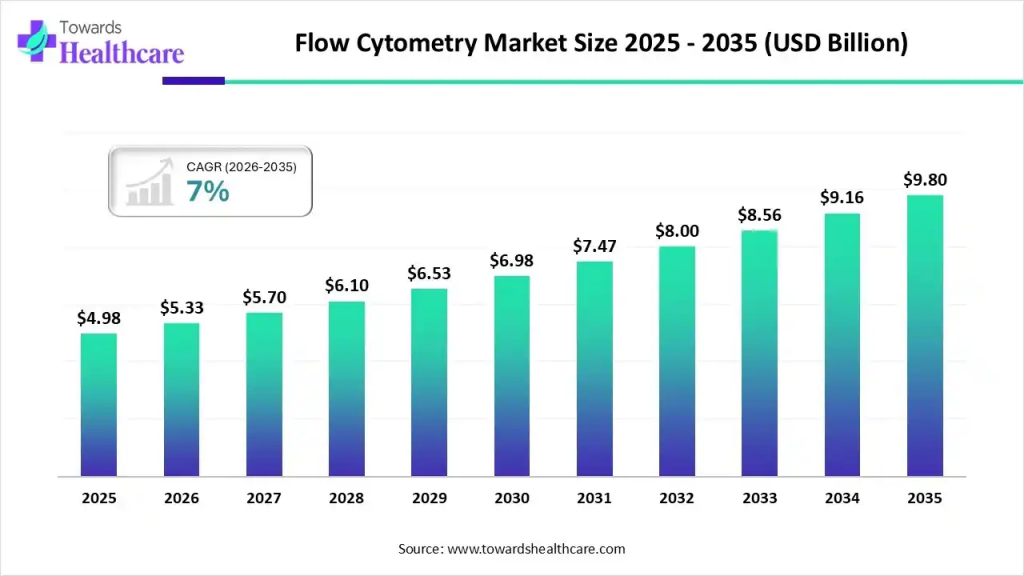
The flow cytometry market is entering a new phase of growth as laboratories, hospitals, pharmaceutical companies, and research institutions increasingly rely on advanced technologies to understand cells at a deeper level. According to the figures provided, the global market is valued at USD 4.98 billion in 2025 and is expected to reach USD 9.80 billion by 2035, expanding at a 7% CAGR from 2026 to 2035.
Flow cytometry has become an important technology for analyzing individual cells, identifying biomarkers, studying immune responses, and monitoring diseases. Its growing role in cancer research, immunology, hematology, drug discovery, and personalized medicine is creating new opportunities for technology providers and life sciences companies.
Why Is Flow Cytometry Becoming More Important?
Modern healthcare is moving toward earlier diagnosis, targeted therapies, and personalized treatment. Flow cytometry supports this shift by allowing researchers and clinicians to examine thousands of cells quickly and identify differences in cell populations.
The technology is widely used in:
- Cancer and hematological disorder research
- Immunology and immune-cell profiling
- Cell and gene therapy
- Drug discovery and development
- Stem cell research
- Infectious disease testing
- Organ transplantation
- Clinical diagnostics
- Biotechnology and bioprocessing
As these applications expand, demand is also increasing for instruments, reagents, software, services, and automated data-analysis platforms.
AI and Automation Are Changing Flow Cytometry
One of the most important trends is the integration of artificial intelligence, machine learning, and automation into flow cytometry workflows.
Traditional analysis can require extensive manual gating and interpretation of large datasets. AI-powered software can help researchers identify cellular patterns, classify populations, reduce repetitive work, and improve consistency.
Advanced analytical platforms are also making it easier to manage high-dimensional datasets generated by modern cytometers. Research into automated gating and machine-learning-based classification demonstrates the potential for AI to improve reproducibility and efficiency in flow cytometry workflows.
Cloud connectivity and digital laboratory platforms are further supporting collaboration by allowing data to be stored, analyzed, and shared across research teams.
Spectral Flow Cytometry Opens New Possibilities
Spectral flow cytometry is becoming an important area of technological development. Unlike conventional approaches that rely on selected fluorescence channels, spectral systems capture broader emission signatures and use computational analysis to distinguish signals.
This enables researchers to work with increasingly complex panels and analyze more cellular markers in a single experiment.
Recent advances are pushing flow cytometry toward higher-parameter analysis, automation, improved sensitivity, and greater flexibility. Scientific reviews published in 2026 highlight the evolution of flow cytometry from conventional multiparameter analysis toward technologies involving high-dimensional fluorescence, mass cytometry, and imaging approaches.
Clinical Applications Continue to Drive Demand
Clinical applications remain one of the strongest areas of adoption. Flow cytometry is widely used in hematology, oncology, immunodeficiency testing, transplantation monitoring, and immune-system analysis.
Its ability to identify specific cell populations makes it particularly valuable in cancer diagnosis and treatment monitoring. It is also increasingly relevant to measurable or minimal residual disease assessment, where highly sensitive cellular analysis can help evaluate whether abnormal cells remain after treatment.
The broader expansion of personalized medicine is expected to create additional opportunities as clinicians increasingly require detailed biological information to guide treatment decisions.
Research and Drug Discovery Create New Opportunities
Academic institutions, biotechnology companies, and pharmaceutical organizations continue to use flow cytometry to understand disease mechanisms and evaluate potential therapies.
In drug discovery, flow cytometry can help researchers examine cellular responses, apoptosis, immune activation, cell viability, and other biological effects. It is also valuable in the development of cell and gene therapies, where detailed characterization of cells is essential.
The growing investment in immuno-oncology, regenerative medicine, stem cell research, and advanced therapies is therefore supporting demand for sophisticated cell-analysis technologies.
Product Trends: Instruments Remain at the Center
Based on the supplied market data, instruments accounted for approximately 38% of the market in 2025, making them the leading product segment.
Modern instruments are evolving beyond basic cell counting. Manufacturers are focusing on:
- Higher parameter detection
- Faster cell analysis
- Improved sensitivity
- Spectral capabilities
- Automated workflows
- Easier operation
- Advanced cell sorting
- Better integration with analytical software
At the same time, software is becoming increasingly important. As instruments generate larger and more complex datasets, laboratories need advanced tools to interpret results efficiently.
Cell-Based Technology Leads the Market
The cell-based segment accounted for approximately 65% of the market in 2025, according to the supplied figures.
Cell-based flow cytometry is widely used for immunophenotyping, cell-cycle analysis, apoptosis studies, cell proliferation, and cell sorting. Its broad use across research and clinical laboratories makes it a fundamental part of modern cellular analysis.
Meanwhile, bead-based flow cytometry is gaining attention because of its applications in multiplexed assays, biomarker detection, and analysis of particles and extracellular vesicles.
North America Maintains Its Leadership
North America accounted for approximately 42% of the market in 2025, supported by advanced healthcare infrastructure, strong research activity, major technology providers, and significant investment in biotechnology.
The United States remains an important hub for flow cytometry innovation because of its large pharmaceutical and biotechnology ecosystem. Hospitals, academic laboratories, research organizations, and clinical testing facilities are increasingly adopting advanced cell-analysis technologies.
Canada is also benefiting from strong biomedical research, healthcare modernization, and growing investment in life sciences.
Asia Pacific Could Be the Fastest-Growing Region
Asia Pacific is emerging as a major growth opportunity for flow cytometry.
Increasing healthcare expenditure, expanding biotechnology industries, growing diagnostic capabilities, and rising research investments are supporting adoption across countries such as China, India, Japan, and South Korea.
China has developed a particularly strong biotechnology and research ecosystem, while India is expanding its clinical diagnostics, pharmaceutical research, and biotechnology capabilities.
As advanced healthcare services become more accessible, demand for sophisticated laboratory technologies is expected to increase across the region.
Europe Strengthens Its Life Sciences Ecosystem
Europe continues to represent an important market for flow cytometry, supported by established biomedical research institutions, pharmaceutical companies, hospitals, and biotechnology organizations.
The region is also focusing on standardization, laboratory reproducibility, and advanced diagnostic technologies. These developments can support broader clinical adoption while encouraging manufacturers to introduce more reliable and user-friendly platforms.
Germany and the UK remain important centers for biomedical research, clinical testing, and biotechnology innovation.
High Equipment Costs Remain a Challenge
Despite strong technological progress, cost remains one of the major barriers to wider adoption.
Advanced flow cytometers can require significant capital investment, while laboratories must also account for reagents, maintenance, software, training, and skilled personnel.
Smaller laboratories and organizations in developing healthcare systems may therefore face challenges in adopting high-end platforms.
Standardization and reproducibility are additional concerns. Differences in instruments, reagents, protocols, and analysis methods can affect results, creating a need for better harmonization across laboratories.
What Does the Future Look Like?
The next decade is likely to bring greater convergence between flow cytometry, AI, automation, spectral analysis, imaging, and precision medicine.
Future systems are expected to become more automated and easier to operate while handling increasingly complex cellular datasets. Software will play a larger role in converting raw measurements into actionable biological insights.
Another important opportunity lies in integrating flow cytometry with other single-cell technologies. Researchers are increasingly seeking deeper information about individual cells rather than relying only on population-level measurements.
This evolution could expand flow cytometry beyond traditional laboratory research and diagnostics into advanced therapeutic development, cell and gene therapy, biomarker discovery, and personalized healthcare.
Competitive Landscape
The flow cytometry industry includes established life sciences and diagnostic companies as well as specialized technology developers.
Major companies include:
- Thermo Fisher Scientific
- Danaher Corporation
- Becton, Dickinson and Company
- Agilent Technologies
- Beckman Coulter Life Sciences
- Cytek Biosciences
- Bio-Rad Laboratories
- Sony
- Sysmex Corporation
- Biotium
- Sartorius
- NanoCellect Biomedical
Competition is increasingly centered on high-parameter analysis, spectral technology, automation, software capabilities, workflow simplicity, and clinical applications.
The Road Ahead
Flow cytometry is moving from a conventional laboratory technique toward a more intelligent and connected cellular-analysis platform.
The combination of advanced instruments, powerful software, AI-assisted interpretation, and growing applications in precision medicine is creating a stronger foundation for future growth.
With the global flow cytometry market projected in the supplied analysis to rise from USD 4.98 billion in 2025 to USD 9.80 billion by 2035, the coming years could be defined by smarter workflows, higher-dimensional cell analysis, and broader clinical adoption.
The real opportunity is no longer simply counting cells—it is turning cellular data into meaningful insights that can support better research, diagnostics, and therapeutic development.
About Us
Healthcare WebWire is a part of Towards Healthcare Research & Consulting is a global healthcare market research and consulting firm dedicated to helping businesses make informed decisions through reliable market intelligence and strategic insights. We serve pharmaceutical, biotechnology, medical device, AI in healthcare, cell and gene therapy, digital health, and life sciences organizations with in-depth market research, custom consulting, competitive analysis, and growth forecasts. Our team combines industry expertise with rigorous research to deliver clear, actionable insights that support market expansion, product strategy, investment decisions, and long-term business growth. From emerging innovations to established healthcare markets, we help organizations understand where the industry is today and where it’s headed tomorrow.
You can place an order or ask any questions, please feel free to contact us at [email protected]
Europe Region – +44 778 256 0738
North America Region – +1 8044 4193 44
APAC Region: +91 9356 9282 04
Visit Our Website: Towards Healthcare Research & Consulting – Expert Consulting Solutions & Research Reports
Find us on social platforms: LinkedIn | Twitter | Instagram | Medium