Gene therapy is rapidly becoming one of the fastest-growing areas in modern medicine. The technology focuses on treating diseases by replacing, modifying, or repairing faulty genes, offering long-term solutions for conditions that previously had limited treatment options. Increasing approvals of advanced therapies, growing investments from governments and private investors, and continuous breakthroughs in gene editing technologies are accelerating market expansion worldwide.
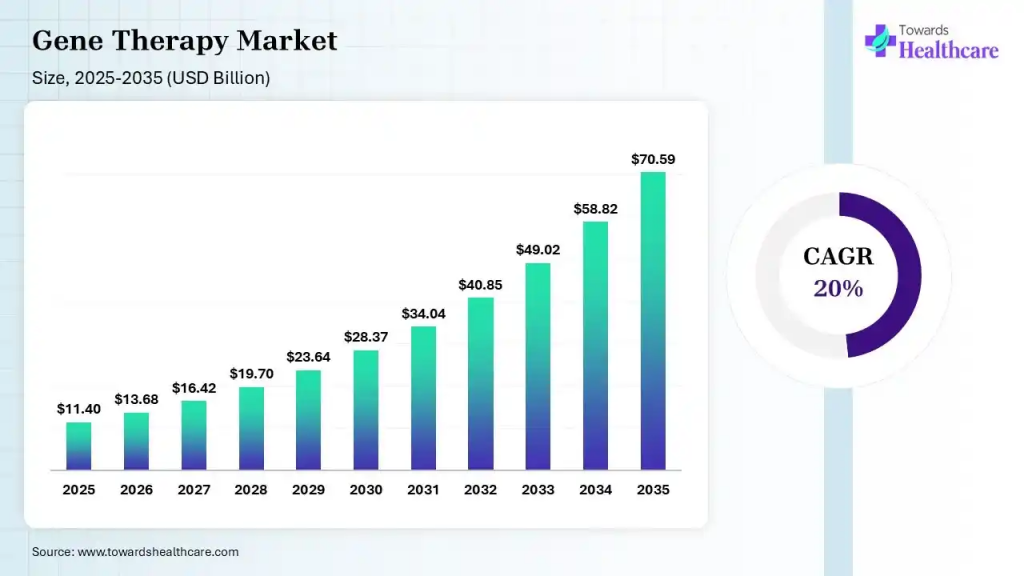
The global gene therapy market is valued at USD 13.68 billion in 2026 and is projected to reach USD 70.59 billion by 2035, growing at a robust CAGR of 20%. The commercialization of gene therapies for cancer, rare diseases, inherited disorders, and neurological conditions continues to create new opportunities for pharmaceutical companies, biotechnology firms, healthcare providers, and investors.
Looking for data that supports your next business decision? Get a FREE sample tailored to your strategic priorities: https://www.towardshealthcare.com/download-sample/5804
Regional Insights
North America Maintains Market Leadership
North America accounted for 45% of the global gene therapy market in 2025, making it the largest regional market. The region benefits from a well-established biotechnology ecosystem, high healthcare spending, favorable reimbursement policies, and a strong regulatory environment led by the U.S. FDA.
The United States remains the innovation hub for gene therapy, supported by increasing clinical trials, advanced manufacturing facilities, and collaborations between pharmaceutical companies and research institutions. Government initiatives such as the NIH’s USD 100 million partnership with the Bill & Melinda Gates Foundation for affordable gene therapies further strengthen the region’s leadership.
Canada is also expanding its position through investments in AI-enabled biomanufacturing and advanced cell and gene therapy production facilities.
Asia Pacific Emerges as the Fastest-Growing Market
Asia Pacific is expected to register the highest growth rate during the forecast period. Countries including China, India, Japan, and South Korea are making significant investments in genomics research, biotechnology infrastructure, and precision medicine.
China continues to expand CRISPR research, viral vector manufacturing, and clinical development, while India is strengthening domestic production through initiatives such as Bio-E3, Vigyan Dhara, and increasing investments in Genome Valley, Hyderabad. Growing healthcare expenditure, improving regulatory support, and rising awareness of rare diseases are expected to accelerate market adoption across the region.
Europe Strengthens Through Government Support
Europe continues to witness steady growth due to favorable government policies and increasing funding for genomics research.
Programs such as the Horizon Europe Mission on Cancer and the 1+ Million Genomes Initiative are encouraging personalized medicine, cross-border genomic research, and next-generation therapeutic development. Germany and the United Kingdom remain among the region’s leading innovation centers for advanced gene therapies.
Market Segmentation Analysis
Therapy Type
In Vivo Gene Therapy Leads the Market
The in vivo gene therapy segment captured approximately 60% of total market revenue in 2025. These therapies deliver genetic material directly into patients using viral vectors, making treatment more efficient while reducing complex laboratory procedures.
Ex Vivo Gene Therapy Shows Highest Growth Potential
Ex vivo therapies are expected to record the fastest growth over the next decade. The increasing adoption of CAR-T cell therapies, gene-edited stem cells, and personalized immune therapies is driving investment across oncology and rare disease applications.
Vector Type
Viral Vectors Continue to Dominate
Viral vectors represented nearly 75% of the global market in 2025. Technologies including AAV, lentivirus, adenovirus, and retrovirus remain the preferred delivery systems because of their high efficiency and proven clinical success.
Non-Viral Vectors Gain Momentum
Non-viral delivery technologies are expected to grow rapidly as companies focus on improving safety, lowering manufacturing costs, and reducing immune-related complications.
Disease Indications
Cancer Represents the Largest Application
Cancer accounted for approximately 40% of the global gene therapy market in 2025. Continuous advancements in CAR-T therapies and precision oncology are significantly expanding treatment options for blood cancers and solid tumors.
Genetic Disorders Become the Next Growth Engine
Gene therapies targeting inherited diseases such as hemophilia, spinal muscular atrophy (SMA), Duchenne muscular dystrophy (DMD), sickle cell disease, and β-thalassemia are expected to witness the fastest market expansion over the coming years.
Delivery Methods
Intravenous (IV) administration remained the leading delivery method, accounting for nearly 50% of total market revenue due to its rapid systemic distribution and widespread clinical use.
Meanwhile, intrathecal and intraocular delivery methods are expected to experience significant growth as neurological and ophthalmic gene therapies continue to advance through regulatory approvals.
End Users
Hospitals dominated the market with approximately 65% revenue share in 2025. Their specialized infrastructure, multidisciplinary care teams, and advanced treatment capabilities make them the preferred setting for administering complex gene therapies.
Specialty clinics are projected to register the fastest growth as outpatient treatment models continue expanding worldwide.
Industry Leaders Continue to Invest Aggressively
The competitive landscape is becoming increasingly dynamic as leading pharmaceutical companies strengthen their gene therapy portfolios through acquisitions, strategic partnerships, and manufacturing expansion.
Some of the industry’s largest participants include Novartis AG, Roche, Gilead Sciences, Bristol Myers Squibb, Amgen, Sarepta Therapeutics, bluebird bio, BioMarin, CRISPR Therapeutics, Legend Biotech, uniQure, Krystal Biotech, and Merck & Co.
Revenue Highlights of Major Companies
- Novartis AG reported annual revenue of approximately USD 53 billion, supported by expanding advanced therapy programs.
- Roche Group generated annual revenue exceeding CHF 60 billion, continuing to invest heavily in precision medicine and genomics.
- Bristol Myers Squibb reported approximately USD 48 billion in annual revenue while expanding its cell therapy portfolio.
- Amgen Inc. generated more than USD 34 billion in revenue through biologics and innovative therapeutics.
- Gilead Sciences, including Kite Pharma, reported approximately USD 28 billion in annual revenue while maintaining leadership in commercial CAR-T therapies.
These companies continue investing billions of dollars in manufacturing facilities, clinical trials, AI-powered drug discovery, and next-generation genome editing technologies to strengthen their competitive positions.
Checkout the Market Report Now at: https://www.towardshealthcare.com/checkout/5804
Investment Activity Continues to Accelerate
Government agencies and private investors are increasing funding for gene therapy research at an unprecedented pace.
Recent initiatives include:
- NIH and the Bill & Melinda Gates Foundation committing USD 100 million to accelerate affordable gene therapies.
- India’s Bio-E3 Policy and Vigyan Dhara programs receiving a combined budget of ₹10,579 crore through 2025-26.
- Large-scale investments in RNA technologies, viral vector manufacturing, and AI-assisted drug development across North America, Europe, and Asia.
Growing venture capital funding and strategic acquisitions are enabling biotechnology startups to accelerate clinical development while helping large pharmaceutical companies expand their genetic medicine portfolios.
Future Outlook
The gene therapy market is entering a transformational decade. Increasing regulatory approvals, expanding treatment pipelines, technological advancements in CRISPR and viral vector engineering, and strong public-private investments are expected to drive sustained growth through 2035.
As manufacturing capacity expands and treatment costs gradually improve, gene therapy is expected to become a mainstream treatment option for cancer, rare diseases, inherited disorders, neurological conditions, and several chronic illnesses. Companies that continue investing in innovation, scalable manufacturing, and strategic collaborations are likely to lead the next generation of precision medicine and redefine the future of global healthcare.
CGT Dashboard Access
Track the rapidly evolving Cell & Gene Therapy landscape with insights on 1,300+ companies, including industry leaders such as Novartis, Bristol Myers Squibb and more . Our dashboard brings together pipeline intelligence, clinical developments, manufacturing capabilities, investments, partnerships, and competitive insights in one place—helping decision makers identify opportunities and stay ahead in the CGT market.
Access the Dashboard: https://www.towardshealthcare.com/cell-gene-intelligence-platform
About Us
Healthcare WebWire is a part of Towards Healthcare Research and Consulting is a global insights and strategy partner focused on advancing cell and gene therapy innovation. We support biotech firms and healthcare leaders with clinical research expertise, data-driven analytics, and strategic consulting. Our goal is to accelerate the development and delivery of next-generation genetic therapies by transforming complex science into actionable, real-world solutions.
You can place an order or ask any questions, please feel free to contact us at [email protected]
Europe Region – +44 778 256 0738
North America Region – +1 8044 4193 44
APAC Region: +91 9356 9282 04
Visit Our Website: https://www.towardshealthcare.com
Find us on social platforms: LinkedIn | Twitter | Instagram | Medium