The global orthopedic braces & supports market is projected to grow from USD 4.09 billion in 2025 to USD 7.65 billion by 2035, at a CAGR of 6.46%, driven by musculoskeletal disorders, aging populations, sports injuries, and technological advancements.

Download Free Sample of Orthopedic Braces & Supports Market Now and Get the Complete Report Easily at: https://www.towardshealthcare.com/download-sample/5983
Market Size
2025 Market Size: USD 4.09 billion
2026 Projected Market Size: USD 4.35 billion
2035 Projected Market Size: USD 7.65 billion
CAGR (2026–2035): 6.46%
Regional Contribution:
North America dominates with ~40% market share in 2024
Asia Pacific expected to grow fastest from 2025 to 2034
Product Segment Insights:
Knee braces and supports: Largest revenue ~35% in 2024
Pediatric braces: Fastest-growing product segment
Mobility Type Insights:
Soft & elastic braces: Dominant in 2024
Hinged braces: Fastest CAGR 2025–2034
Distribution Channel Insights:
Orthopedic clinics & hospitals: Dominant (48% revenue share in 2024)
E-commerce platforms: Fastest CAGR 2025–2034
End User Insights:
Adults: Dominant in 2024
Geriatric: Fastest-growing segment 2025–2034
Market Trends
Increasing prevalence of musculoskeletal disorders affecting 1.71 billion people worldwide.
Aging population increases demand due to arthritis, fractures, and mobility issues.
Rising sports injuries drive the need for functional and hinged braces.
Technological advancements like 3D printing, robotic-assisted surgeries, and AI integration.
Government initiatives (e.g., India’s EPCMD) support innovation and exports.
Post-operative rehabilitation focus increases demand for orthopedic supports.
Healthcare infrastructure improvements in APAC drive market growth.
Rising awareness of non-surgical treatments like conservative ACL/PCL management.
Pediatric orthopedics growth due to customized braces for developmental and neuromuscular disorders.
Digital orthopedics and e-commerce expansion enhance accessibility and patient engagement.
AI Impact / Role in Market
Precision fitting using AI-based 3D scanning and modeling.
Diagnostic assistance from AI analyzing radiographs, MRIs, and patient records.
Rehabilitation monitoring through AI-enabled apps tracking brace usage and progress.
Surgical planning support integrating AI with robotic-assisted surgeries.
Predictive analytics to forecast injury recurrence and recovery timelines.
Design optimization to reduce material usage while ensuring stability.
Remote consultations via AI chatbots and virtual triage platforms.
Custom pediatric braces designed using AI for growth adaptation.
Market intelligence using AI to identify trends and demand for brace types.
Enhanced patient experience with AI-driven virtual fitting and adjustment tutorials.
5. Regional Insights
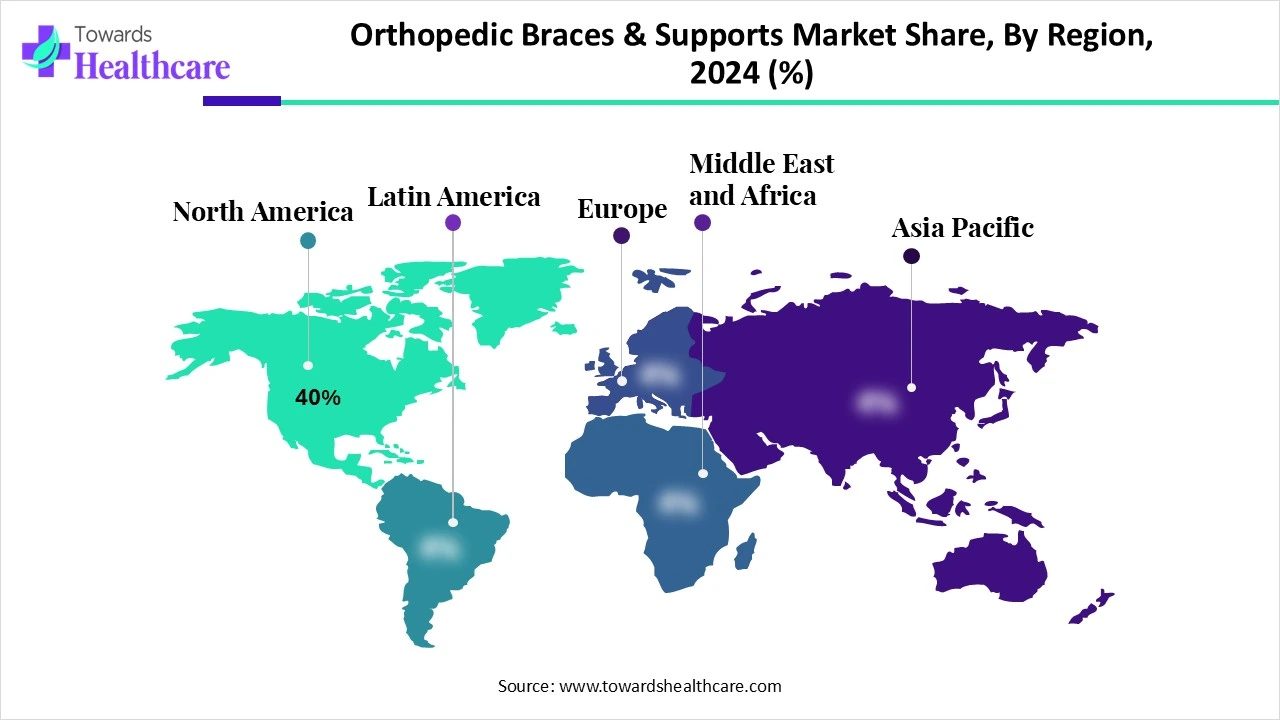
North America (Dominant)
Revenue share: 40% in 2024
Early adoption of advanced technology like robotic-assisted surgeries
Aging population drives demand for orthopedic specialists and devices
Example: Johnson & Johnson MedTech launched KINCISE 2 Surgical Automated System (June 2025)
Asia Pacific (Fastest Growing)
Rapid government investment in healthcare infrastructure
Rising musculoskeletal disorders due to sedentary lifestyle and obesity
Increased focus on mobility disorder R&D and AI-based healthcare solutions
Key markets: China, India, Japan, South Korea
Europe
Aging population over 50 increases fracture risk
Government initiatives like The European Action Towards Better Musculoskeletal Health
Germany: ~831,000 fragility fractures annually
UK: Poor musculoskeletal health affects 19 million people
Latin America & MEA
Rising awareness and accessibility of orthopedic devices
Expansion of healthcare services and rehabilitation programs
Market Dynamics
Drivers:
Rising musculoskeletal disorders leading to reduced mobility and early retirement.
Technological innovation with AI integration, 3D printing, and robotic-assisted surgeries.
Government support through policies and export incentives.
Aging population requiring braces for arthritis, fractures, and ligament injuries.
Sports injuries and active lifestyle increasing demand for functional braces.
Restraints:
High cost due to advanced materials, custom fitting, and regulatory compliance.
Opportunities:
Dynamic PCL knee braces for posterior tibial translation correction.
Conservative ACL rehabilitation expanding non-surgical treatment options.
Digital orthopedics and e-commerce platforms for remote monitoring and sales.
Top 10 Companies
1. DJO Global, Inc.
-
Products: Knee, ankle, back, wrist, shoulder, pediatric braces and supports.
-
Overview: Global medical device company focused on orthopedic, vascular, and surgical solutions. Provides a wide range of braces, supports, and rehabilitative products.
-
Strength: Strong R&D capabilities, wide hospital network, recognized brand, and diverse orthopedic portfolio.
2. Össur hf.
-
Products: Functional knee braces, prosthetics, compression supports, back and spinal braces.
-
Overview: Iceland-based company specializing in non-invasive orthopedic solutions and prosthetics. Known for innovative designs and patient-centric solutions.
-
Strength: Advanced technology in functional and dynamic braces, strong global presence, focus on improving mobility.
3. Breg, Inc.
-
Products: Knee braces, back braces, ankle braces, rehabilitation devices.
-
Overview: U.S.-based company providing orthopedic devices for rehabilitation, injury prevention, and post-operative care.
-
Strength: Expertise in rehabilitation-focused products, strong hospital and clinic partnerships, and effective post-surgical solutions.
4. Bauerfeind AG
-
Products: Compression therapy devices, orthopedic supports, back braces, knee braces.
-
Overview: German company focused on high-quality orthopedic and compression products, leveraging biomechanics research.
-
Strength: Premium product quality, evidence-based design, strong reputation in Europe, and biomechanical innovation.
5. 3M Company
-
Products: Orthopedic tapes, soft supports, braces, post-op aids.
-
Overview: Multinational conglomerate with a healthcare division specializing in orthopedic supports and rehabilitation aids.
-
Strength: Manufacturing expertise, global distribution network, strong brand recognition, and innovation in materials.
6. Zimmer Biomet Holdings, Inc.
-
Products: Knee, back, hip braces, and joint supports.
-
Overview: U.S.-based global leader in musculoskeletal healthcare, providing both surgical and non-surgical orthopedic solutions.
-
Strength: Strong surgical integration, innovative product portfolio, extensive global reach, and robust R&D.
7. DeRoyal Industries, Inc.
-
Products: Soft goods, knee and ankle supports, pediatric braces, post-operative aids.
-
Overview: U.S. company manufacturing custom and off-the-shelf orthopedic braces and supports for rehabilitation and injury management.
-
Strength: Customization capabilities, flexible production, strong supply chain, and wide variety of products.
8. Thuasne Group
-
Products: Elastic braces, functional knee braces, back and spinal supports.
-
Overview: French company specializing in orthopedic devices, elastic and functional braces, focusing on prevention and recovery.
-
Strength: Strong European market presence, high-quality elastic and functional braces, and emphasis on patient comfort.
9. medi GmbH & Co. KG
-
Products: Soft braces, compression supports, knee and ankle braces.
-
Overview: German company focusing on medical aids and orthopedic devices, especially soft and elastic supports.
-
Strength: Research-backed product design, premium quality, strong European distribution, and expertise in soft brace technology.
10. Ottobock SE & Co. KGaA
Products: Prosthetics, knee braces, spinal supports, ankle-foot orthoses, pediatric braces.
Overview: German multinational focused on mobility solutions, including braces, prosthetics, and orthopedic devices.
Strength: Advanced R&D in prosthetics and braces, global presence, integration of robotics and AI, and innovative product design.
Latest Announcements
Aspen Medical Products acquired Advanced Orthopaedics (Jan 2025) to expand bracing solutions globally.
Johnson & Johnson MedTech launched KINCISE 2 Surgical Automated System (June 2025) to enhance surgical efficiency.
Recent Developments
Demetra Holding acquired 51% stake in GetSet Surgical (Feb 2025) – spine surgical solutions expansion.
Aspen Medical Products expanded portfolio beyond spine into bracing solutions through acquisition (Jan 2025).
SpineGuard and Omnia Medical strengthened strategic partnership for expansion of products including PsiFGuard in U.S. (Jan 2025).
Xtant Medical Holdings launched OsteoFactor Pro to improve bone healing in orthopedic surgeries (May 2025).
HURT! & Relatient launched AI-based platform for patient triage and online appointment scheduling (Feb 2025).
Market Segments Covered
1. By Product Type
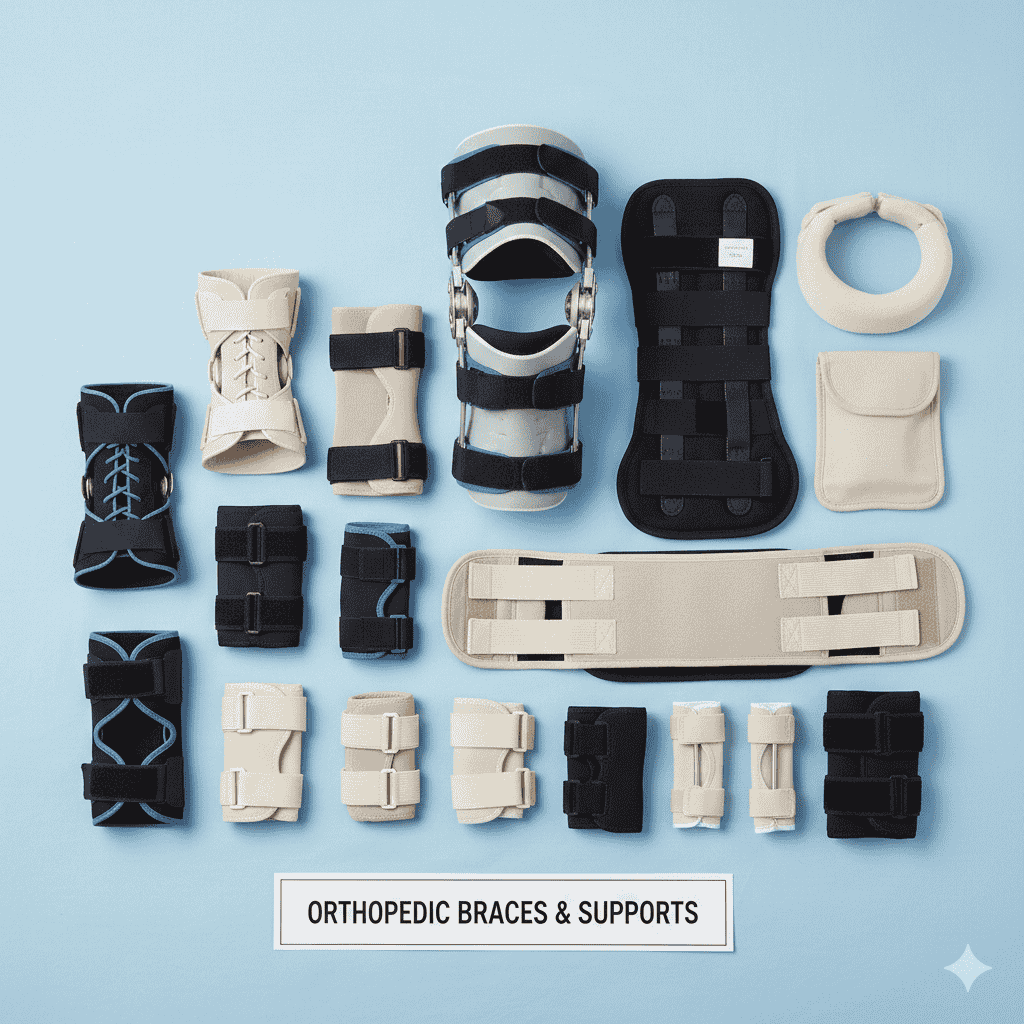
1.1 Knee Braces & Supports
Types: Functional, prophylactic, rehabilitative
Explanation:
Functional braces stabilize the knee post-injury, especially for ACL, MCL, and meniscus tears.
Prophylactic braces prevent injuries in athletes or individuals at risk.
Rehabilitative braces aid in post-operative recovery, providing controlled mobility to avoid further damage.
Market Insight: Knee braces dominate the product type segment (~35% revenue in 2024) due to widespread knee injuries and arthritis prevalence.
1.2 Ankle Braces & Supports
Explanation:
Used to prevent ankle sprains, provide compression, and stabilize weak or recovering joints.
Common in sports medicine and post-injury rehabilitation.
Growth Drivers: Sports injuries, aging populations, and high mobility requirements.
1.3 Back, Hip & Spine Braces
Explanation:
Provide spinal alignment, pain relief, and support for degenerative disorders, fractures, or post-surgical care.
Includes lumbar supports, thoracic braces, hip stabilizers.
Market Insight: Increasing aging population and spinal disorders contribute to steady demand.
1.4 Wrist & Hand Braces
Explanation:
Used for carpal tunnel syndrome, arthritis, tendon injuries, or post-fracture recovery.
Supports immobilization while allowing partial movement when necessary.
1.5 Elbow & Shoulder Braces
Explanation:
Treat injuries like tennis elbow, rotator cuff tears, or post-surgical recovery.
Enhances mobility and stabilizes the joint during healing or rehabilitation.
1.6 Pediatric Braces
Types: Scoliosis, clubfoot, cerebral palsy correction devices
Explanation:
Correct developmental deformities, improve posture, and assist in neuromuscular conditions.
Custom-made to fit the growing anatomy of children, often recommended by pediatric orthopedic specialists.
Growth Insight: Fastest-growing product type due to increased diagnosis and awareness of pediatric musculoskeletal issues.
2. By Mobility Type
2.1 Soft & Elastic Braces
Explanation:
Provides gentle support, improves proprioception, stimulates muscles surrounding injured joints.
Typically used in acute or sub-acute rehabilitation phases.
Market Insight: Dominant segment in 2024 due to comfort, ease of use, and widespread adoption in clinics and home care.
2.2 Rigid Braces
Explanation:
Offers structural stability and immobilization of joints to prevent movement that can worsen injury.
Used in fractures, post-surgical recovery, and chronic instability.
Strength: Ensures mechanical protection for healing or weakened joints.
2.3 Hinged Braces
Explanation:
Provides maximum stability with controlled lateral and rotational support.
Common for moderate to severe ligament injuries, osteoarthritis, and meniscus repair.
Growth Insight: Fastest-growing mobility type due to increasing sports injuries and post-operative needs.
3. By Distribution Channel
3.1 Orthopedic Clinics & Hospitals
Explanation:
Traditional and dominant distribution channel (48% revenue in 2024).
Braces are often prescribed and fitted by orthopedic specialists, ensuring correct sizing and effectiveness.
Strength: High credibility and patient trust, immediate access to professional care.
3.2 Retail Pharmacies
Explanation:
Provide off-the-shelf supports and soft braces for minor injuries or preventive care.
Strength: Convenient for quick purchase, particularly for adults and elderly patients with recurring joint pain.
3.3 E-commerce Platforms
Explanation:
Online sales of orthopedic supports and braces with home delivery.
Includes AI-assisted sizing guides, virtual consultations, and remote monitoring.
Growth Insight: Fastest-growing channel due to digital adoption, remote diagnosis, and convenience.
3.4 Rehabilitation Centers
Explanation:
Provide braces and supports as part of structured physiotherapy programs.
Common for post-surgery, stroke, or severe injury recovery.
3.5 Sports Medicine Clinics
Explanation:
Offer braces for prevention, recovery, and injury management in athletes.
Focus on functional and hinged braces to allow activity while supporting healing.
4. By End User
4.1 Adults
Explanation:
Largest end-user segment.
High demand due to arthritis, sports injuries, occupational injuries, and post-operative recovery.
4.2 Pediatric
Explanation:
Customized braces for congenital or developmental disorders.
Increasing awareness among parents and pediatric physicians drives market growth.
4.3 Geriatric
Explanation:
Fastest-growing end-user segment.
Older adults face slower healing, fractures, osteoporosis, and degenerative joint conditions.
Growth Insight: Specialized geriatric braces enhance mobility, reduce fall risk, and improve quality of life.
5. By Region
5.1 North America
Dominant market (40% revenue share).
Drivers: Advanced healthcare infrastructure, aging population, early adoption of robotic surgeries and AI-based orthopedics.
5.2 Asia Pacific
Fastest-growing region.
Drivers: Rising musculoskeletal disorders, government healthcare initiatives, expanding medical device infrastructure, increased awareness of non-surgical treatments.
5.3 Europe
Growing due to aging population and high fracture incidence.
Strong government programs for musculoskeletal health.
5.4 Latin America
Emerging market with increasing adoption in rehabilitation and preventive care.
5.5 Middle East & Africa (MEA)
Growth supported by rising healthcare awareness, improving hospital infrastructure, and growing demand for advanced braces.
Top 5 FAQs
-
What is the projected market size by 2035?
USD 7.65 billion with a CAGR of 6.46%. -
Which region dominates the market?
North America with ~40% revenue share in 2024. -
Which product segment generates the most revenue?
Knee braces and supports (~35% of market revenue in 2024). -
What drives market growth?
Aging population, rising musculoskeletal disorders, sports injuries, technological innovations, and AI integration. -
Which end-user segment is growing fastest?
Geriatric patients due to higher fracture incidence, slower recovery, and tailored orthopedic care.
Access our exclusive, data-rich dashboard dedicated to the medical devices industry – built specifically for decision-makers, strategists, and industry leaders. The dashboard features comprehensive statistical data, segment-wise market breakdowns, regional performance shares, detailed company profiles, annual updates, and much more. From market sizing to competitive intelligence, this powerful tool is one-stop solution to your gateway.
Access the Dashboard: https://www.towardshealthcare.com/access-dashboard
Checkout Orthopedic Braces & Supports Market Report Now at: https://www.towardshealthcare.com/checkout/5983
Become a valued research partner with us – https://www.towardshealthcare.com/schedule-meeting
You can place an order or ask any questions, please feel free to contact us at sales@towardshealthcare.com
Powering Healthcare Leaders with Real-Time Insights: https://www.towardshealthcare.com/healthcare-intelligence-platform
Europe Region – +44 778 256 0738
North America Region – +1 8044 4193 44
APAC Region: +91 9356 9282 04
Visit Our Website: https://www.towardshealthcare.com
Find us on social platforms: LinkedIn | Twitter | Instagram | Medium | Pinterest
About the Author