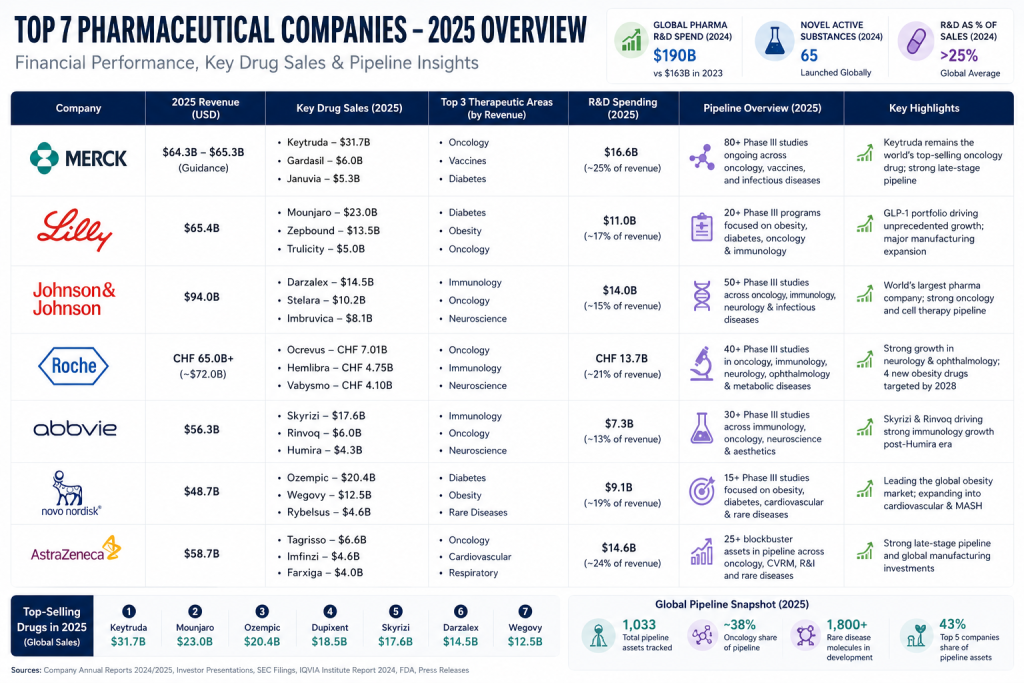
The pharmaceutical industry in 2025–2026 is increasingly being shaped by a “winner-takes-most” innovation cycle, where a small group of high-impact therapies are generating disproportionate global revenues and redefining strategic priorities across major players. Instead of diversified but slower growth, the sector is now being driven by high-conviction therapeutic franchises, particularly in oncology, metabolic disorders, immunology, and rare diseases.
MSD (Merck & Co.) — Oncology-Led Powerhouse
MSD continues to anchor its growth on the strength of Keytruda, which alone contributes nearly half of the company’s pharmaceutical revenue base at ~$31.7B. This makes it one of the most commercially successful oncology drugs in history.
What’s structurally important is not just the revenue, but the pipeline depth—with 80+ Phase III studies, MSD is effectively building a multi-layered oncology ecosystem spanning early, mid, and late-stage cancers. This reduces single-product dependency risk while reinforcing long-term dominance in immuno-oncology.
Eli Lilly — The GLP-1 Disruption Leader
Eli Lilly has transitioned from a traditional pharma company into a metabolic disease superpower. The explosive growth of Mounjaro (~$23B) and Zepbound (~$13.5B) has placed it at the center of the global obesity and diabetes treatment wave.
Together, GLP-1-based therapies now contribute more than $36B+ in annual sales, making metabolic health one of the most lucrative pharmaceutical categories globally. This shift has fundamentally re-rated Lilly as a high-growth biotech-like pharma leader rather than a legacy drug company.
AbbVie — Post-Humira Reinvention Success
AbbVie has successfully navigated the most critical transition in its corporate history: post-Humira revenue stability.
- Skyrizi (~$17.6B) has emerged as a best-in-class immunology asset
- Rinvoq continues to deliver consistent double-digit growth
This dual-immunology franchise is now replacing Humira’s legacy dominance, proving that AbbVie has effectively re-built its immunology moat through next-generation therapies rather than relying on a single blockbuster.
Roche — Multi-Platform Expansion Strategy
Roche continues to balance strong existing franchises like Ocrevus, Hemlibra, and Vabysmo, which provide stable cash flow across neurology, hematology, and ophthalmology.
At the same time, Roche is strategically pivoting into metabolic diseases, especially obesity therapeutics, where it is reportedly targeting multiple approvals by 2028. This signals a long-term shift toward entering one of the fastest-growing global therapeutic markets.
Johnson & Johnson — Scale-Driven Global Leader
With ~$94B in revenue, Johnson & Johnson remains the largest pharmaceutical company globally. Its strength lies in diversified resilience, not dependency on a single molecule.
Key growth engines include:
- Darzalex (oncology cornerstone)
- Stelara (immunology transition asset)
- Expanding cell and gene therapy investments
J&J’s strategy is increasingly focused on combining pharma + advanced therapeutics platforms, ensuring long-term leadership across multiple innovation cycles.
Novo Nordisk — Obesity Market Monopoly Position
Novo Nordisk continues to dominate the global obesity and diabetes treatment space with Ozempic and Wegovy, which have become two of the most commercially successful drugs worldwide.
With nearly $49B in annual revenue, the company is essentially operating at the center of a global demand shock in metabolic disease treatment, where supply constraints and massive unmet demand continue to define growth dynamics.
AstraZeneca — Oncology + Pipeline Acceleration
AstraZeneca has crossed $58B in revenue, driven by strong oncology performance and expanding rare disease and respiratory portfolios.
A defining feature of AstraZeneca’s strategy is aggressive pipeline reinvestment, including:
- Expansion in oncology combinations
- Rare disease platforms
- Large-scale manufacturing infrastructure scaling
This positions AZ as one of the most pipeline-intensive growth pharma companies globally.
Top Pharmaceutical Blockbusters (2025 Landscape)
The current global revenue concentration is highly skewed toward a few mega-blockbusters:
- Keytruda → $31.7B
- Mounjaro → $23B
- Ozempic → $20B
- Dupixent → $18.5B
- Skyrizi → $17.6B
- Darzalex → $14.5B
- Wegovy → $12.5B
These drugs collectively represent a structural shift where chronic diseases, immunology, oncology, and metabolic disorders dominate pharma economics.
Industry-Level Structural Shift
The broader pharmaceutical ecosystem is undergoing a transformation driven by:
- $190B+ annual global R&D investment
- Rapid expansion of GLP-1/metabolic drug category
- Continued dominance of oncology as the highest-value therapeutic area
- Rising importance of biologics, cell therapy, and precision medicine
- Increasing pipeline concentration in fewer, higher-impact molecules
Want to know how the market is performing across different regions? Visit our databook for detailed stats and numbers: https://www.towardshealthcare.com/dashboard/
Contact us for more:
Europe Region – +44 778 256 0738
North America Region – +1 8044 4193 44
APAC Region: +91 9356 9282 04
Visit Our Website: https://www.towardshealthcare.com